
Large format graphics that are built to last, not just to look good at launch.
Scale changes everything in print. A colour, a material, a finish that works perfectly at A4 behaves completely differently at three metres wide. We help clients understand what will actually perform at scale, in their specific environment, before production starts — so the result looks as good in three years as it does on day one.
Where large format graphics earn their place.
Large format is not just about size. It is about transformation. The right installation does not just fill a wall — it changes how a space feels, how people move through it, and how a brand is perceived the moment someone walks in.

-
Environmental wall graphics and murals
-
School and educational corridor graphics
-
Hotel lobby and reception installations
-
Development hoardings and site branding
-
Entrance and reception feature walls
-
Wayfinding systems at scale
-
Retail and hospitality campaign graphics
-
Event backdrops and branded environments
-
Window and glazing graphics
-
Office and workplace environmental branding
What makes large format specification different from standard print.
Three things matter above everything else when specifying large format work: the surface it will live on, the environment it will be exposed to, and how long it needs to perform. We assess all three before recommending a substrate, laminate or fixing method. A wall graphic that looks perfect at installation but fails within a year is not a successful project — it is an expensive mistake.
Surface assessment
Every surface behaves differently. Painted plasterboard, raw brick, textured render, glass, metal and uneven historic walls all require different materials and different adhesion approaches. We assess the actual surface before specifying anything.
Material performance at scale
Colours shift at scale. Seams need managing. Panels need to align precisely across large areas. The material choices that work beautifully at small sizes can fail at large format if the specification is wrong. We know the difference.
Environmental conditions
UV exposure, humidity, temperature fluctuation and daily traffic all affect how a large format installation performs over time. A school corridor, a hotel lobby and an outdoor hoarding are three completely different environments requiring three completely different specifications.
Installation logistics
Large format installations require access planning, surface preparation, phased installation scheduling and in many cases specialist equipment. We manage all of this so the client does not have to.
Real-world constraints we regularly work around.
The brief is rarely the most complex part of a large format project. The environment usually is.
Uneven or textured surfaces that standard vinyl cannot bond to reliably without surface preparation or specialist materials
01
Safeguarding requirements in schools that govern who can be on site, when, and how — including DBS requirements for installers
02
Listed or historic buildings where fixing methods must be completely non-invasive and reversible
03
Live hospitality environments — hotels, restaurants, venues — where installation cannot disrupt guests or daily operation
04
Phased projects where sections are installed over time and must match precisely across weeks or months
05
High-traffic environments where the installation needs to withstand daily contact, cleaning and wear without deteriorating
06
What this looks like in practice.
Private Education — Wiltshire
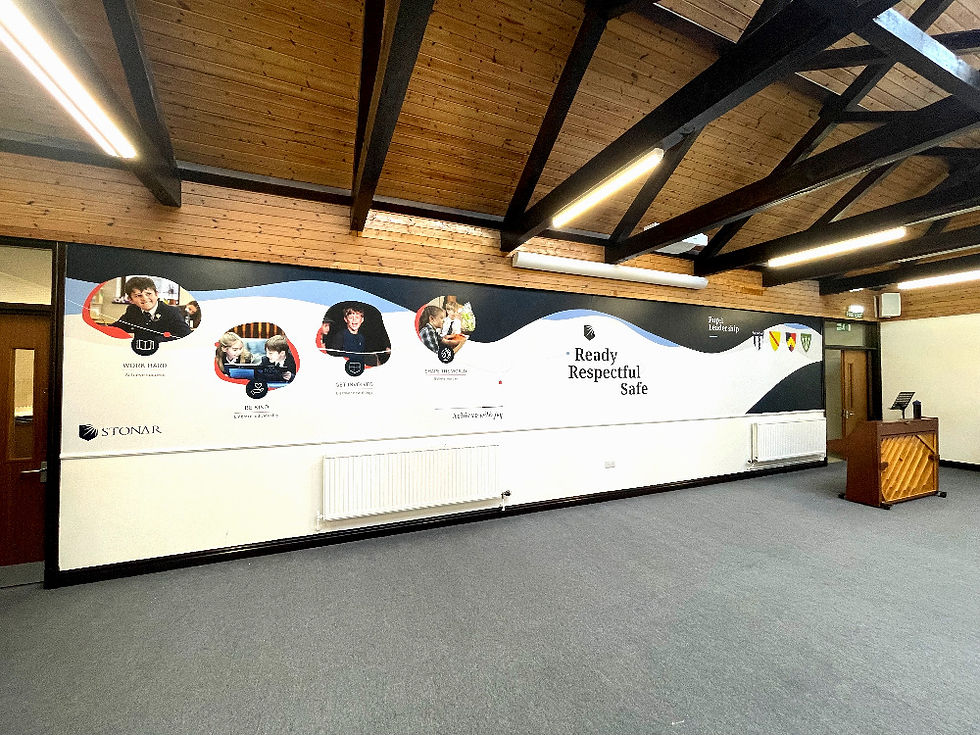
A private school in Wiltshire needed large format wall graphics installed across multiple corridors in a working school environment. The surfaces were uneven, with exposed pipework and architectural irregularities that ruled out standard vinyl application. Installation needed to happen during term time, within safeguarding guidelines, without disrupting students or staff.
We assessed every surface before specifying a single material. Drytac Polar Grip Air paired with a Weathershield Matte laminate was selected specifically for its ability to bond reliably to uneven surfaces without preparation, while delivering vibrant colour and long-term durability under daily use. Installers were DBS checked. The schedule was built around the school day.
The installation was completed on time, without disruption, and two years later it performs exactly as specified.


Why the conversation before the brief matters.
Most large format projects that go wrong do so before anything is printed. The artwork is signed off before the surface has been assessed. The substrate is chosen based on price rather than performance. The installation is booked before the access constraints are understood.
We get involved before any of those decisions are made. The most valuable conversation in a large format project is the one that happens at the planning stage — when there is still time to specify correctly, schedule properly and avoid the surprises that come with getting it wrong.
If you are at the early stages of a project and want to talk through what will actually work before the brief is finalised, that is exactly the kind of conversation we are built for.

Where we work.
We specify and install large format graphics for clients across Bath, Bristol, Swindon, Wiltshire, Chippenham, the Cotswolds and South Wales. For large scale development projects and multi-site installations, we are happy to discuss locations further afield.
Talk to us before you brief
The most important conversation in a large format project happens before the artwork is finalised. If you are planning an installation and want to talk through the specification, the surface, the environment and the timeline before anything is committed, we are easy to reach.

Questions clients ask us about large format graphics.
Large format printing is used to produce graphics at a scale beyond standard commercial print, including wall graphics, window graphics, hoarding, murals, event backdrops, branded panels and environmental graphics.
The production method is only part of the specification. At larger sizes, the surface, viewing distance, panel joins, colour consistency, expected lifespan and installation method all become more important.
Large format graphics can be used temporarily for an event or campaign, or specified to remain in place for several years. The right material depends on where the graphic is going and what it needs to withstand, rather than simply how large it needs to be.
What is large format printing and what is it used for?
There is no single best material for wall graphics. The right choice depends on the wall surface, paint finish, texture, expected lifespan and how much contact or cleaning the graphic will receive.
Smooth painted walls may work with a standard self-adhesive wall vinyl, while textured, uneven or difficult surfaces can require a higher-tack adhesive or a specialist material designed to achieve better contact.
A protective laminate can also be added where the graphic needs to withstand regular cleaning, scuffs or daily contact.
We prefer to assess or test the actual surface before specifying the vinyl. A material that performs perfectly on one painted wall can fail on another if the paint chemistry or surface condition is different.
What is the best material for wall graphics?
Yes, wall graphics can be applied to many painted and textured surfaces, but the vinyl and adhesive need to be matched to the wall.
Smooth, sound painted surfaces are generally straightforward. Textured plaster, blockwork, brick and uneven walls may require specialist conformable or higher-tack materials.
Paint condition matters too. Fresh paint needs time to cure, while some washable, stain-resistant and low-VOC paints can have surfaces that are difficult for adhesives to bond to reliably.
For larger installations, we may carry out an adhesion test before production. That is much safer than assuming a vinyl will work because the wall looks smooth.
Can wall graphics be applied to painted or textured walls?
Wall graphics usually peel because the adhesive has not formed a reliable bond with the surface underneath.
Common causes include unsuitable paint, dust or contamination on the wall, insufficient curing time after painting, moisture, surface texture, low temperatures during installation or simply using a vinyl that was not designed for that particular substrate.
Failure can also begin at edges, corners and joins where the graphic experiences additional movement or contact.
This is why surface assessment matters before artwork goes into production. Changing the vinyl after a graphic has been printed and installed is considerably more expensive than identifying an adhesion problem at the start of the project.
Why do wall graphics peel away from the wall?
Large format graphics can last from a few weeks to several years depending on the material, location, exposure and intended use.
Temporary event graphics can be specified for easy removal after a short campaign.
Permanent internal wall graphics may remain in place for years, particularly where the correct vinyl and protective laminate have been used.
External graphics are affected by UV exposure, rain, temperature changes and wind, so inks, substrates and laminates need to be suitable for outdoor use.
We normally start by asking how long the graphic actually needs to perform. There is little value in specifying a five-year material for a six-week campaign, just as there is little value in saving on material if the installation needs to remain presentable for several years.
How long do wall graphics and large format graphics last?
Before installation, check the surface, measurements, access, artwork, panel layout, environmental conditions and anything that could restrict the installation team.
For wall graphics, the wall should be assessed for paint condition, texture, moisture and adhesion. For external graphics, weather exposure and fixing conditions become more important.
Large installations may also require ladders, towers or powered access equipment, which can affect when and how the work can take place.
In schools, hotels and other live environments, installation timing may need to work around safeguarding, guests, staff or public access.
These details are best resolved before production starts. Once several metres of graphics have been printed, discovering that the surface, access or measurements are wrong becomes an expensive problem.